
Archive
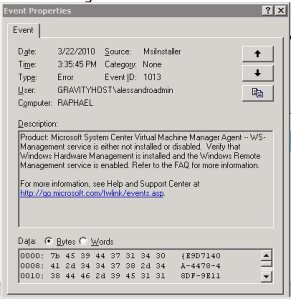
Microsoft System Center Virtual Machine Manager Agent — WS-Management service is either not installed or disabled.
"Product: Microsoft System Center Virtual Machine Manager Agent — WS-Management service is either not installed or disabled. Verify that Windows Hardware Management is installed and the Windows Remote Management service is enabled. Refer to the FAQ for more information." 
You should install the KB 936059. This update adds a new feature to Windows Remote Management (WinRM). This update also updates the version of Windows Remote Management that is included with Windows Server 2003 R2
Post-installation instructions
On a Windows Server 2003 R2-based computer that has the Windows Hardware Management optional component installed, the WsmanSelRg collector-initiated subscription collects events form the BMC. This subscription has a URI property that is set to wsman:microsoft/logrecord/sel. After you apply this hotfix, the WsmanSelRg subscription will not work until you set the URI property to the following:
To set the URI property, run the following command at a command prompt:
wecutil ss WsmanSelRg /uri:"http://schemas.microsoft.com/wbem/wsman/1/logrecord/sel
Windows 2008 R2 : No Restrictions for Network adapter teaming in cluster environment
In Windows Server 2008 and Windows Server 2008 R2, there are no restrictions that are associated with NIC Teaming and the Failover Clustering feature and allows it to be used on any network interface in a Failover Cluster.
The following table details the recommended, supported, and not recommended network configurations for live migration, and is organized in the order in which each network configuration is commonly used. Before reviewing the table, note the following:
- When a network adapter is connected to a virtual switch, it is referred to as a virtual network adapter.
- Network access for virtual machines can be on either a public or private network. To allow virtual machines access to computers on the physical network, they must be on a public network. The requirements for virtual machine access vary depending on network I/O needs and the number of virtual machines you are running on a single physical server.
- In addition to the preferred network for the cluster and the Cluster Shared Volumes, a cluster can utilize at least one additional network for communication. This increases the high availability of the cluster. The cluster should also be on a private network.
- If a network configuration is listed as “not recommended” in the following table, it should not be used because the performance of live migrations declines and cluster nodes might crash. Add another network adapter to separate traffic between live migration and Cluster Shared Volumes.
| Host configuration | Virtual machine access | Management | Cluster and Cluster Shared Volumes | Live migration | Comments |
|---|---|---|---|---|---|
|
4 network adapters with 1 Gbps |
Virtual network adapter 1 |
Network adapter 2 |
Network adapter 3 |
Network adapter 4 |
Recommended |
|
3 network adapters with 1 Gbps; 2 adapters are teamed for link aggregation (private) |
Virtual network adapter 1 |
Virtual network adapter 1 with bandwidth capped at 10% |
Network adapter 2 (teamed) |
Network adapter 2 with bandwidth capped at 40% (teamed) |
Supported |
|
3 network adapters with 1 Gbps |
Virtual network adapter 1 |
Virtual network adapter 1 with bandwidth capped at 10% |
Network adapter 2 |
Network adapter 3 |
Supported |
|
2 network adapters with 10 Gbps |
Virtual network adapter 1 |
Virtual network adapter 1 with bandwidth capped at 1% |
Network adapter 2 |
Network adapter 2 with bandwidth capped at 50% |
Supported* |
|
2 network adapters with 10 Gbps; 1 network adapter with 1 Gbps |
Virtual network adapter 1 (10 Gbps) |
Network adapter 2 (1 Gbps) |
Network adapter 3 (10 Gbps) |
Network adapter 2 with bandwidth capped at 50% |
Supported |
|
2 network adapters with 10 Gbps; 2 network adapters with 1 Gbps |
Virtual network adapter 1 (10 Gbps) |
Network adapter 2 (1 Gbps) |
Network adapter 3 (1 Gbps) |
Network adapter 4 (10 Gbps) |
Supported |
|
3 network adapters with 1 Gbps; 2 adapters are teamed for link aggregation (public) |
Virtual network adapter 1 |
Virtual network adapter 1 with bandwidth capped at 5% |
Network adapter 2 (teamed) |
Network adapter 2 with bandwidth capped at 90% (teamed) |
Not recommended |
|
2 network adapters with 1 Gbps |
Virtual network adapter 1 |
Virtual network adapter 1 with bandwidth capped at 10% |
Network adapter 2 |
Network adapter 2 with bandwidth capped at 90% |
Not recommended |
|
1 network adapter with 10 Gbps; 1 network adapter with 1 Gbps |
Virtual network adapter 1 (10 Gbps) |
Virtual network adapter 1 with bandwidth capped at 10% |
Network adapter 2 (1 Gbps) |
Network adapter 2 with bandwidth capped at 90% |
Not recommended |
*This configuration is considered recommended if your configuration has a redundant network path available for Cluster and Cluster Shared Volumes communication.
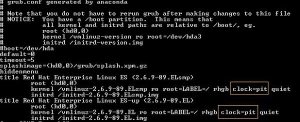
Hyper-V : The system time runs too fast on a Linux-based vm


Download a Set of Free Tools for Managing Hyper-V R2
VMM : Lan Migration using BITS fail with error: HostAgentFail (2912) … and HRESULT: 0x800704DD
This error occur when you either a new virtual machine creation or during a virtual machine migration over the network (LAN migration using BITS)
Confirm and if this is the case, make the vmmagent service run as localsystem on both the VMM Server computer and on all the Host and Library server computers.
2. The Log On account for the VMMService windows service on the VMM server computer is running under an account other than localsystem.
Althoug using domain account is a fully supported scenario, however, the domain account ( e.g. contososcvmmadmin) needs to be logged into the VMM server computer in order for BITS jobs to complete successfully. Login as that account and then try the operation again. It should work.
Hyper-V R2 : Storage/Network Design for High Availability
By converting your physical servers to virtual ones, you immediately get extra capabilities that make them less likely to go down and easier to bring back up when they do:
- · Snapshots enable you to go back in time when a software update or configuration change blows up an otherwise healthy server.
- · Virtual hard disks consolidate the thousands of files that comprise a Windows server into a single file for backups, which significantly improves the reliability of those backups.
- · Volume Shadow Copy Service (VSS) support, which is natively available in Hyper-V, means that applications return from a restore with zero loss of data and immediately ready for operation.
- · Migration capabilities improve planned downtime activities by providing a mechanism for relocating the processing of virtual machines to new hosts with little to no disruption in service.
- · Failover clustering means that the loss of a virtual host automatically moves virtual machines to new locations where they can continue doing their job.
What’s become much more critical is that the servers/application/services to keep on working.
To Provide High Availability, we need to design properly our environment. With the right combinations of technology, you can inexpensively increase the availability of your environment.
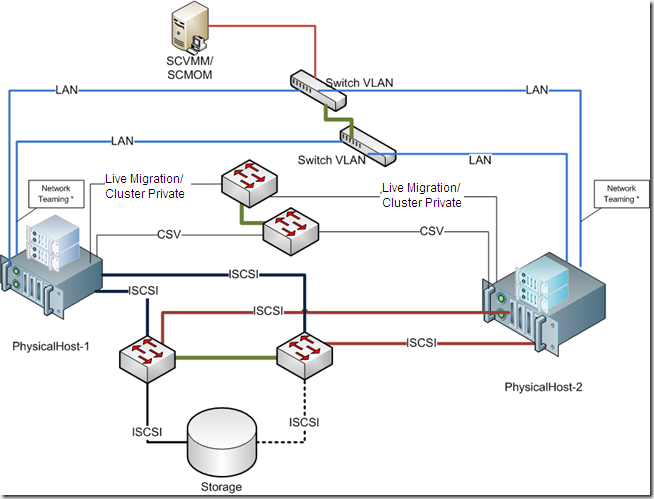
The best practices are based on the following design principles:
- · Redundant hardware to eliminate a single point of failure
- · Load balancing and failover for iSCSI and network traffic
- · Redundant paths for the cluster, Cluster Shared Volume (CSV), and live migration traffic
- · Separation of each traffic type for security and availability
- · Ease of use and implementation
Remember: Windows Server 2008 R2 Enterprise or Windows Server 2008 R2 Datacenter must be used for the physical computers. These servers must run the same version of Windows Server 2008 R2, including the same type of installation. That is, both servers must be either a full installation or a Server Core installation
Also, Hyper-V requires an x64-based processor, hardware-assisted virtualization, and hardware-enforced Data Execution Prevention (DEP). Specifically, you must enable the Intel XD bit (execute disable bit) or AMD NX bit (no execute bit).
Servers
Server-class equipment. The use of equipment that is not listed in the Windows catalog can impact supportability and may not best meet the needs of your virtual machines. Moving to tested and supported server-class equipment will ensure full support in the case of a problem. ). The Windows Server catalog is available at the Microsoft Web site http://go.microsoft.com/fwlink/?LinkId=111228
iSCSI Storage
I would recommend Dell Equalogic, Compellent, IBM NetApp, EMC, but you should evaluate others vendors.
iSCSI Software
If you need to use software-based iSCSI, look carefully at the features available. Microsoft clustering requires iSCSI to support SCSI Primary Commands-3, specifically the support of Persistent Reservations. Most for-cost iSCSI software currently supports this capability, but there is very little support for it in most open source software packages.
One inexpensive and easy-to-use software package is the StarWind iSCSI Target from StarWind Software. There is a free version of StarWind iSCSI target allowing multiple connections. You cannot get it filling automatic form on their site. You have to ask support@starwindsoftware.com for free NFR unlock key manuallyNetwork
How about the network configuration? Here is my proposal and this is what I am using in terms of NICs/Ports:1 management2 private: 1 for cluster private/CSV primary, 1 for live migration primary2 for network (in teaming)2 for iSCSI2 Dedicated (NIC/Ports) for the Network traffic configured as teaming.The failover cluster should be disabled from managing this network.
Provided by establishing the Hyper-V virtual switch on a network team. The team can provide load balancing, link aggregation, and failover capabilities to the virtual network
NIC teaming is the process of grouping together several physical NICs into one single logical NIC, which can be used for network fault tolerance and transmit load balance. The process of grouping NICs is called teaming. Teaming has two purposes:• Fault Tolerance: By teaming more than one physical NIC to a logical NIC, high availability is maximized. Even if one NIC fails, the network connection does not cease and continues to operate on other NICs.• Load Balancing: Balancing the network traffic load on a server can enhance the functionality of the server and the network. Load balancing within network interconnect controller (NIC) teams enables distributing traffic amongst the members of a NIC team so that traffic is routed among all available paths.2 Dedicated (NIC/Ports) for the CSV. (Minimum 1Gb). I personally recommend 10Gb. One a 2 nodes you can use cross-over, but if you plan to use more, than you need a switch. If you choose 10GB it means that your switch needs to be 10GB.
A feature of failover clusters called Cluster Shared Volumes is specifically designed to enhance the availability and manageability of virtual machines. Cluster Shared Volumes are volumes in a failover cluster that multiple nodes can read from and write to at the same time. This feature enables multiple nodes to concurrently access a single shared volume.CSV will provide many benefits, including easier storage management, greater resiliency to failures, the ability to store many VMs on a single LUN and have them fail over individually, and most notably, CSV provides the infrastructure to support and enhance live migration of Hyper-V virtual machines.Cluster private traffic will flow over the private network with the lowest cluster metric (typically has value of 1000). To view the cluster network metrics that have been assigned, run the following PowerShell command:
To view the cluster network metric settings, run the following Power Shell commands:Import-Module FailoverClusters
Get-ClusterNetwork | ft Name, Metric, AutoMetricIf the automatically assigned metrics are not the desired values, then the following Power Shell commands can be executed to manually set the metric values:Get-ClusterNetwork | ft Name, Metric, AutoMetricNote the name of the networks that you want to set the values on (used for next command)$cn = Get-ClusterNetwork “<cluster network name>”
$cn.Metric = <value>Cluster private/CSV should have a value of 1000
Live migration should have a value of 11002 Dedicated (NIC/Ports) for the iSCSI traffic.( Minimum 1Gb). I personally recommend 10Gb ( the difference in price will be about 10% more).Btw, remember: If you choose 10GB it means that your switch needs to be 10GB, also the Storage.
The mass-storage device controllers that are dedicated to the cluster storage should be identical. They should also use the same firmware version.Isolating iSCSI traffic to its own network path isolates that traffic to its own network segment, ensuring its full availability as network conditions change.A multipath I/O software needs to be installed on the Hyper-V hosts to manage the disks properly. This is done by first enabling Hyper-V-based MPIO support which is not installed by default.Also, Enable Jumbo frames on the two interfaces identified for iSCSI1 (NIC/Port) for the Management. External management applications (SCVMM, DMC, Backup/Restore, etc) communicate with the cluster through this network.Resuming :
Desktop Virtualization Hour. What are my virtualization options?
What are my virtualization options?
Looking at virtualization but unsure about your options? Thinking about migrating to Windows 7? Interested in VDI and Server Virtualization? Want to save on costs but wondering about ROI? How to improve IT flexibility? Have more questions than answers?
Ready, Set, Virtualize.
Join Microsoft, industry experts and IT leaders online for a Desktop Virtualization Hour on March 18th at 9am PST. Save the date on your calendar.
Virtualization Summit 2010 in Australia. Ready, Set, Virtualize
Thinking about migrating to Windows 7? Interested in VDI and Server Virtualization? Want to save on costs but wondering about ROI? How to improve IT flexibility? Have more questions than answers?
Learn how server & desktop virtualization can help you:
- Build a desktop virtualization management strategy that helps you manage your applications, data, mobile workers and multiple physical and virtual form factors.
- Reduce desktop costs.
- Enable flexible and agile IT through virtualization.
- Increase desktop security and compliance.
- Improve business continuity and end user productivity.
- Understand how Microsoft is building a solid foundation for a private cloud.
- Increase end user productivity and streamline your IT management with Windows 7.
| Where/When : Canberra, May 6, 2010 | , | (Venue and Registration Links Coming Soon!) |
SCVMM 2008 R2 : User cannot connect to the virtual machine by using the Self-Service Portal
or if the user is not added or removed from the Self-Service User role because the create virtual machine job is running, check if :
- A new virtual machine was created, and the owner of the virtual machine is a member of the Self-Service User role.
- While the create virtual machine job is running, a user is added or removed from the Self-Service User role.
If you are experincing these, you shoud install the : Update for System Center Virtual Machine Manager 2008 R2 (KB978560). This update is available on Microsoft Update but also, you can manually download the hotfix rollup from the Microsoft Update Catalog, visit the following Microsoft Web site:
If the rollup was downloaded from the Microsoft Update Catalog, do the following to install the hotfix rollup package on the Virtual Machine Manager server:
- Extract the VmmServer64Update-RETAIL.cab to a temporary directory.
- Open an elevated command prompt, and then run the following command to install the update:
msiexec /update vmmServer64Update-RETAIL.msp BOOTSTRAPPED=1
Note The name of the package varies based on the version that was downloaded.
- After the hotfix rollup package is installed on the Virtual Machine Manager server, update the VMM agent on the Hyper-V and Virtual Server hosts
Note : A restart is required if the Virtual Machine Manager or Virtual Machine Manager Agent service is running when the hotfix rollup package is installed on the Virtual Machine Manager server.
Security update for Vulnerability in Windows Server 2008 Hyper-V that could Allow Denial of Service
Security updates are available from Microsoft Update and Windows Update. Security updates are also available from the Microsoft Download Center. You can find them most easily by doing a keyword search for "security update."
|
Windows Server 2008 (all editions) : Download here
You must restart your system after you apply this security update. |
|
Microsoft provides detection and deployment guidance for security updates. Microsoft Baseline Security Analyzer (MBSA) allows administrators to scan local and remote systems for missing security updates as well as common security misconfigurations.
The latest version of MBSA has been released: Microsoft Baseline Security Analyzer 2.1.1. For more information, see Microsoft Baseline Security Analyzer 2.1.
Recommended Books


System Center 2012 R2 Virtual Machine
System Center Virtual Machine Manager 2012 Cookbook


