
Archive
System Center VMM 2012 SP1 CTP2: What’s new
Microsoft announced the availability of CTP2 of System Center 2012 SP1.
With support for Windows 2012 and SQL 2012 introduced in CTP1, here are what’s more :
. Network Virtualization: Introduced in CTP1, this release adds support for using DHCP to assign customer addresses and for using either the IP rewrite or IP encapsulation mechanism to virtualize the IP address of a virtual machine.
· VHDX support: Introduced in CTP1, you can now convert from .vhd to .vhdx. In addition, placement determines the format of a VHD based on the OS of the destination host (when you create a virtual machine with a blank virtual hard disk), and the provisioning of a physical computer as a Hyper-V host supports the use of a .vhdx file as the base operating system image.
· Storage Enhancements: Support for the new Windows Standards-Based Storage Management service, which enables you to discover storage by using multiple provider types. In addition, this release adds support for the thin provisioning of logical units, and for the discovery of Serial Attached SCSI (SAS) storage.
· Provisioning a Hyper-V Host Enhancements: Support for performing deep discovery to retrieve detailed information about physical network adapters.
· Support for VMM Console Add-Ins: You can now create Add-Ins and extend the VMM console. Add-Ins allow you to enable new actions or additional configuration for VMM objects by writing an application that uses context passed about the selected VMM objects. You can also embed custom WPF UI or web portals directly into the console’s main views to provide a more fully-integrated experience.
In App Controller, you can deploy and manage in a single console, applications running in Windows Azure PaaS, IaaS, on premises VMM clouds, and clouds provided by hosting providers. In addition, there are the following new features:
· Windows Azure Virtual Machine support: In addition to supporting Windows Azure PaaS workloads, App Controller adds support to the newly announced IaaS virtual machines in CTP2. You can easily deploy, manage, and operate Windows Azure Virtual Machines.
· Copy VMs from private cloud to public cloud: In CTP2, you can select a VMM private cloud VM and copy it to Windows Azure. App Controller makes upload disk, convert settings, and deploying a new virtual machine into an easy migrate flow!
· Hosting Provider support: In addition to on premises VMM private cloud and Windows Azure public cloud, App Controller supports connecting to VMM clouds at a hosting provider. You can connect to a hosting provider and manage user access to these clouds. You can also deploy, manage, and operate virtual machines at the hosting provider.
Also, check the the Project code-named “Service Provider Foundation” for System Center 2012 Service Pack 1 (SP1) provides a rich set of web services that manages Virtual Machine Manager (VMM) for System Center 2012 SP1. The infrastructure of Virtual Machine Manager is exposed through “Service Provider Foundation” as a web service. Because of this, you can manage this System Center component through the web services; for example, you can create or delete virtual machines.
“Service Provider Foundation” provides a web service that acts as an intermediary between web-based administration client and server applications. The web service supports REST-based requests using the OData protocol. The web service handles these requests through Windows PowerShell scripts to communicate and manage server applications.
VMM 2012 : SMI-S Providers : Supported Storage Arrays
VMM 2012 : the following storage arrays supports the new storage automation features
List Updated up to May 2, 2012
Note: For the SMI-S provider type, a value of “proxy” indicates that you must install the SMI-S provider on a server that the VMM management server can access over the network by IP address or by FQDN. Do not install the SMI-S provider on the VMM management server itself.
| Manufacturer/Series | Model | Download Link | Protocol | Minimum Controller Firmware | SMI-S Provider Type | Provider Version |
| DellCompellent | Storage Center | Dell Compellent Solutions | iSCSI/FC | SC 5.5.4 and later,EM 5.5.5 and later | Proxy* | 1 |
| EMCSymmetrix | VMAX/VMAXe | EMC PowerLink | FC | Enginuity 5875 or later | Proxy* | 4.3 |
| EMC/VNX | VNX | EMC PowerLink | iSCSI | Flare 31 or later | Proxy* | 4.3 |
| EMC/CX4 | All | EMC PowerLink | iSCSI/FC | Flare 30 | Proxy* | 4.3 |
| HP/P10000 | V800/V400 | Embedded | iSCSI/FC | HP 3PAR InForm OS 3.1.1.P10 | Embedded | 1.4 |
| HP/P2000 G3 | Embedded | iSCSI/FC | TS240 | Embedded | 1.5 | |
| HP/P6000 | P6300/P6500 | HP | iSCSI/FC | 1000 0000 | Proxy* | 1.4 |
| IBM/DS8000 | 941/951/961 | Embedded | FC | Embedded | 5.6.x5.7.x | |
| IBM/XIV | 2810/2812 (Gen 2) | Embedded | iSCSI/FC | Embedded | 10.2.010.2.1,10.2.2, 10.2.4.x | |
| IBM/XIV | 2810/2812 (Gen 3) | Embedded | iSCSI/FC | Embedded | 11.011.1 | |
| NetApp/FAS | All | NetApp NOW | iSCSI/FC | 7.2.5 (7-mode) | Proxy* | 4.0.1 |
20th Australian System Administrators’ Conference
The 20th Australian System Administrators’ Conference (a milestone event for Systems Administration in Australia) will be held 2 – 5 October in the Hilton Cairns Hotel.
This is the premier Systems Administration event in the Asia-Pacific region.
The Technical Program is being held 2-3 October 2012; followed by two days of Tutorials on 4 and 5 October 2012
I will be presenting the session : Private Cloud with Windows 2012 Hyper V and System Center VMM 2012
Registratiosn are now open : http://conference.sage-au.org.au/files/registration-form_31052012
More info : http://conference.sage-au.org.au/
See you there!!
Windows 2012 Release Candidate : Available
Windows Server Home Page:
http://www.microsoft.com/en-us/server-cloud/
Windows Server 2012 Release Candidate: http://technet.microsoft.com/en-us/evalcenter/hh670538.aspx
Windows Server 2012 Remote Server Administration Tools (RSAT) for Windows 8 Client:
http://www.microsoft.com/en-us/download/details.aspx?id=28972
Video Demos of Network Virtualization, Stroage Spaces, Live Migration, Server Management
High Availabilty. Why Hyper-V delivers better
That’s kind of interesting subject to talk about
Taking as a sample 3 cluster node, where every node has 1(one) connection to a shared storage.
By using VmWare, if one of the VmWare hosts ever lose the IP storage connectivity ( an fault on the ISCSI nic for example ), your Virtual Machines are on the dark, you will probably receive an Blue Screen. The VmWare monitoring will try to start (vmotion) the Virtual machine on the same host or on any other host that has storage connectivity.
Now, the clever solution from the Hyper-V
if the one of the Hyper-V hosts lose IP storage connectivity ( an fault on the ISCSI nic for example ), the Hyper-V will redirect the Storage traffic to the CSV and the VM still working : no blue screen, no restart.
In a Hyper-V Failover Cluster with CSV, all storage I/O is Direct I/O meaning each node hosting a virtual machine(s) is writing directly (via Fibre Channel, iSCSI, or SAS connectivity) to the CSV volume. But in case of lost of Storage connectivity in one of the hosts the traffic will be redirected over the CSV network to another node Host in the cluster which still has direct access to the storage supporting the CSV volume. This functionality prevents the loss of all connectivity to storage. Instead, all storage related I/O is redirected over the CSV network. This is very powerful technology as it prevents a total loss of connectivity thereby allowing virtual machine workloads to continue functioning.
Of course there are other fault scenarios to consider and yes, I know that the recommedation is to have redundant storage connection, but that’s kind of expensive solution and does not take the fact that the Hyper-V solution is more clever.
If you ever experienced this situation I would like to hear your input.
Determine Windows Server 2012 readiness : MAP Toolkit v7.0 Beta now available. Find out about more new features
Key Features for a detailed insight to address an upgrade, migration, virtualization :
- Understand your readiness to deploy Windows in your environment with Windows readiness assessments
- Determine Windows Server 2012 Beta readiness
- Investigate how Windows Server and System Center can manage your heterogeneous environment through VMware migration and Linux server virtualization assessments
- Size your desktop virtualization needs for both Virtual Desktop Infrastructure (VDI) and session-based virtualization using Remote Desktop Services
- Ready your information platform for the cloud with the SQL Server 2012 discovery and migration assessment
- Evaluate your licensing needs with usage tracking for Lync 2010, active users and devices, SQL Server 2012 and Windows Server 2012 Beta
You can use the MAP Toolkit to accomplish the following tasks:
- Desktop and server migration to a Windows Operating System such as Windows 8, Microsoft Office 2010, Microsoft Office 365, and Windows Server 2012, Windows 7 and Windows Thin PC.
- Assess and identify computers running Windows Server operating systems in your environment.
- Assess and identify computers running virtual technologies in your environment.
- Discover and report on computers running Microsoft, VMware, HP-UX and Linux platforms, including the Linux, Apache, MySQL, and PHP (LAMP) application stacks in your environment.
- Assess and identify computers that have outdated or no security-based software (antispyware, antivirus, and firewall products) in your environment.
- Discover and report on computers that are virtual machine candidates.
- Assess and inventory Microsoft SQL Server® instances, databases, and components in your environment.
- Discover MySQL, Oracle, and Sybase databases in your environment and assess the ability to migrate to Microsoft SQL Server.
- Dual-core 1.5GHz processor, 2 GB RAM (Itanium processors are not supported)
Operating system. Any of the following:
- Windows Server 2012, W2008R2 SP2, W2008 SP2 (x86 or x64 versions)
- Windows 7 SP1 (x86 or x64 versions)
- Windows Vista SP2 (x86 or x64 versions)
Software pre-req
- Windows Installer 4.5 (download from http://go.microsoft.com/fwlink/?LinkId=129687)
- .NET Framework 3.5SP1 (3.5.30729.01) (download from http://go.microsoft.com/fwlink/?LinkId=129686)
- .NET Framework 4.0 (Full) (download from http://go.microsoft.com/fwlink/?LinkId=186913)
- Update 2 for Microsoft.NET Framework 4.0 (download from http://support.microsoft.com/kb/2544514). Full download http://go.microsoft.com/fwlink/?LinkId=207290
- By default, the MAP Toolkit will install SQL Server 2012 Express LocalDB during setup.
Note: if you create an instance named “MAPS” before running the MAP Toolkit installer, you may also use an existing installation of SQL Server 2008, SQL Server 2008 R2, or SQL Server 2012 . The MAP Toolkit requires the collation order of the database engine to be set to “SQL_Latin1_General_CP1_CI_AS”.
Recommendations
- Do no install on a domain controller.
- Close all open applications before running the setup wizard.
- If your firewall doesn’t accept listing a service like WMI or Remote Administration, you will also need to open ports 135 and 1024-65535. The reason for this has to do with the way RPC works. WMI uses DCOM to communicate with remote machines, and DCOM uses RPC extensively
- If the computer is in a workgroup, you must manually change the “Network access: Sharing and security model for local accounts” policy setting from Guest only to Classic on the local computer
- To connect remotely and perform the WMI inventory, you will need to provide accounts that are members of the local Administrators group on the computer being inventoried
Collectors by Inventory Scenario:
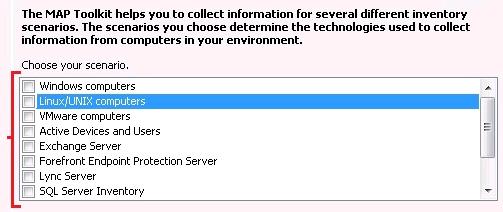
- Windows computers – WMI
- Linux/UNIX computers – SSH
- VMware computers – VMware
- Active Devices and Users – Active Directory, WMI
- Exchange Server – Active Directory, WMI
- Forefront Endpoint Protection Server – PowerShell, WMI
- Lync Server – PowerShell, SQL Native, SQL Windows, WMI
- SQL Server Inventory – WMI
- SQL Server with Database Details – SQL Native, SQL Windows, WMI
- Windows Azure Platform Migration – Oracle, SQL Native, SQL Windows, SSH, WMI
- MySQL, Oracle and Sybase – Oracle, SSH, WMI
download from http://go.microsoft.com/fwlink/?LinkId=219165
Everything You Wanted to Know and Ask about Windows Deployment
Are you interested in Windows Deployment ? Have a look in this 2 webcasts from MS :
TechNet Webcast: Everything You Wanted to Know and Ask about Windows Deployment (Part 1)
Registration URL: http://go.microsoft.com/?linkid=9807963 or http://bit.ly/JLTQLM
Date/ Time: Tuesday, May 15, 2012 – 9-10am (Pacific)
Abstract: In this demonstration-rich, question and answer webcast, Windows Product Manager Stephen Rose moderates an open conversation with Microsoft Deployment Toolkit Product Manager Michael Niehaus and deployment guru Johan Arwidmark. They discuss the new Microsoft Deployment Toolkit 2012 release as well as tips and tricks from the experts about using the Windows Deployment Toolkit.
__________
TechNet Webcast: Everything You Wanted to Know and Ask about Windows Deployment (Part 2)
Registration URL: http://go.microsoft.com/?linkid=9807964 or http://bit.ly/Kgny8y
Date/ Time: Thursday, May 17, 2012 – 9-10am (Pacific)
Abstract:In this demonstration-rich, question and answer webcast, Windows Product Manager Stephen Rose moderates an open conversation with Microsoft Deployment Toolkit Product Manager Michael Niehaus and deployment guru Johan Arwidmark. They discuss the new Microsoft Deployment Toolkit 2012 release as well as tips and tricks from the experts about using the Windows Deployment Toolkit.
Start your Private Cloud evaluations with System Center 2012
Get started with System Center 2012 by downloading/installing or by atteding Microsoft hands on sessions. Details below:
- Private Cloud Evaluation – Start you Private Cloud evaluations with System Center 2012 + Windows Server 2008 R2 SP1 Evaluation bits.
The Microsoft private cloud evaluation includes:
System Center 2012
- System Center 2012 Unified Installer is a utility designed to perform new, clean installations of System Center 2012 for testing and evaluation purposes only. If you want to upgrade from an existing System Center installation or choose set up options such as high availability or multi-server component installs, please refer instead to the System Center 2012 component installation guides located on the Microsoft Private Cloud Evaluation Resource Page.
- System Center 2012 App Controller provides a common self-service experience across private and public clouds that can help you empower application owners to easily build, configure, deploy, and manage new services.
- System Center 2012 Configuration Manager provides comprehensive configuration management for the Microsoft platform that can help you empower users with the devices and applications they need to be productive while maintaining corporate compliance and control.
- System Center 2012 Data Protection Manager provides unified data protection for Windows servers and clients that can help you deliver scalable, manageable, and cost-effective protection and restore scenarios from disk, tape, and off premise.
- System Center 2012 Endpoint Protection, built on System Center Configuration Manager, provides industry-leading threat detection of malware and exploits as part of a unified infrastructure for managing client security and compliance that can help you simplify and improve endpoint protection.
- System Center 2012 Operations Manager provides deep application diagnostics and infrastructure monitoring that can help you ensure the predictable performance and availability of vital applications and offers a comprehensive view of your datacenter, private cloud, and public clouds.
- System Center 2012 Orchestrator provides orchestration, integration, and automation of IT processes through the creation of runbooks that can help you to define and standardize best practices and improve operational efficiency.
- System Center 2012 Service Manager provides flexible self-service experiences and standardized datacenter processes that can help you integrate people, workflows, and knowledge across enterprise infrastructure and applications.
- System Center 2012 Virtual Machine Manager provides virtual machine management and services deployment with support for multi-hypervisor environments that can help you deliver a flexible and cost effective private cloud environment.
- Attend an IT Camp – Learn more and get hands on by attending an IT Camp on the Microsoft Private Cloud. These in person workshops give you hands on experience with a range of Microsoft technologies.
- Get Certified in Microsoft Cloud technologies by taking advantage of the recently announced redesign of Microsoft Certification which includes certifications focused on cloud computing.
Windows 2012: NEW XPS format : oxps is not compatible with Windows 7 xps format.
Come on, this is something that I would not like to blog about : compatibility with previous versions
Today I saved on document as XPS and I noticed the .OXPS format. Very good that now we have support for the standard OpenXPS format.
The issue came up when I tried to open the document on my Windows 7 virtual machine : it could not open the .oxps document and for my surprise there is no Windows 7 update/fix to apply ( until today, 24/04/2012) that will allow you to open that .oxps
So, based on this article, http://technet.microsoft.com/en-us/windows/hh859698, I had to change the Windows 8 Default XPS format to the Microsoft XPS format, and after that, I had to open the .oxps and print it again, this time selecting Microsoft XPS format.
Note: In this article Microsoft mention about an XPSConverter.exe tool, but it is not available to download http://technet.microsoft.com/en-us/query/hh846189
I hope we got this change for RTM version, or at least the release of the XPSConverter.exe tool for public release/use
Windows Server 2012: Hyper-V Network Virtualization
Hyper-V Network Virtualization allow customers to keep their own internal IP addresses when moving to the cloud while providing isolation from other customers’ VMs – even if those VMs happen to use the exact same IP addresses.
The way it works is that each VM receive two IP addresses :
The first one, the IP address visible in the VM, is relevant in the context of a given tenant’s virtual subnet. Following the IEEE nomenclature we call this the Customer Address (CA).
The other IP address is relevant in the context of the physical network in the cloud datacenter. This is called the Provider Address (PA). This decoupling of tenant and datacenter IP addresses provides many benefits.
One of the benefits is that you can move your VMs to the cloud without modifying the VM’s network configuration and without worrying about what else (or who else) is sitting in that datacentre.
Another big reason is the policy enforcement in the end hosts that provides a scalable solution for multi-tenant isolation, instead of using Vlan’s, for isolation.
There are 2 different mechanisms to virtualize the IP address:
Generic Routing Encapsulation (GRE) : should be used for network virtualization, because it provides the most flexibility and performance. It will be used for most environments/deployments
IP Rewrite : may be appropriate to provide performance and compatibility in some current high-capacity datacenters.
A very good article was posted by Jeffrey about this topic
Recommended Books


System Center 2012 R2 Virtual Machine
System Center Virtual Machine Manager 2012 Cookbook


 Cloudtidings.com