

- User interface changes in response to feedback we received from beta testers
- Support for dynamic memory on Standard & Web editions of Windows Server
Archive
Posts Tagged ‘Windows 2008R2 SP1’
Private Cloud Solutions : Hyper-V Cloud Deployment Guides
November 18, 2010
4 comments
Private cloud is the implementation of cloud services on resources that are dedicated to your organization, whether they exist on-premises or off-premises with the benefits of public cloud computing—including self-service, scalability, and elasticity and the additional control and customization.
Build your own private cloud and you will have a dynamic, virtualized infrastructure with advantages including:
- Pools of compute resources
- Automated management
- High-availability
- Scale-out capabilities
- Multi-tenancy
- Self-service provisioning
To learn more how to build your own private cloud with Windows Server 2008 R2 Hyper-V, System Center, and the Virtual Machine Manager Self-Service Portal 2.0 using the Hyper-V Clould Deployment Guide:
Hyper-V Cloud Program
November 9, 2010
Leave a comment
To help you deploy commercial private and public clouds based on Windows Server 2008 R2 Hyper-V, System Center, and related products, Microsoft offers a set of programs and initiatives called Hyper-V Cloud. These programs can help you:
- Build your own private cloud with help from the Hyper-V Cloud Deployment Guides and Hyper-V Cloud partners.
- Get a pre-validated private cloud configuration from Hyper-V Cloud Fast Track OEM partners. Hyper-V Cloud Fast Track partners have worked with Microsoft to combine hardware and software offerings based on a reference architecture for building private clouds.
- Find a service provider in the Hyper-V Cloud Service Provider Program who can host a dedicated private cloud for you.
Microsoft is also investing in a set of engagements to help customers with IaaS assessments, proofs-of-concept, and deployments with help from our partners or Microsoft Services. The investments are designed to help reduce the risk, cost, and time associated with testing and deploying a cloud environment.
Hyper-V Cloud Fast Track Partners
Get an infrastructure as a service private cloud with a pre-validated configuration from server partners in the Hyper-V Cloud Fast Track. Offerings from the Fast Track program combine Microsoft software; consolidated guidance; validated configurations from OEM partners for compute, network, and storage; and value-added software components.
Hyper-V Cloud Fast Track partner offerings provide flexibility and choice while reducing risk and increasing the speed of deployment. Read the solution briefs below to learn about the available options from each partner.
For Dell solution, click here
Physical to Virtual (P2V) Migration : Download
November 9, 2010
Leave a comment
Microsoft P2V Migration for Software Assurance automates the delivery of an updated and personalized Windows 7 operating system while backing up and converting the legacy Windows XP or later desktop and its applications for seamless use within Windows 7. P2V Migration supports both native Microsoft Deployment Toolkit (MDT) Lite Touch Installation as well as Microsoft System Center Configuration Manager 2007 Zero Touch Installation.
System Requirements
- Supported Operating Systems:Windows 7;Windows Vista;Windows XP
- Microsoft Word or Microsoft Word Viewer 2003 (available as a free download) can be used to view Word documents
- Microsoft Office Compatibility Pack for Word, Excel, and PowerPoint File Formats (available as a free download) can be used to open, edit, and save documents, workbooks, and presentations in the file formats new to Microsoft Office
To install P2VMigration.msi:
- Double-lick the P2VMigration.msi.
- Accept the Microsoft Software License Terms.
- Follow the steps in the installation process to complete the installation
Download P2V Migration for Software Assurance now:
http://www.microsoft.com/downloads/en/details.aspx?FamilyID=14d08880-bd5e-4602-a747-2717d3f54cb2
Categories: Virtualization
P2V, Virtualisation, Windows 2008R2 SP1, Windows Server® 2008 R2
Windows 2008R2 SP1: Changes that were made to the Hyper-V Manager
November 4, 2010
Leave a comment
In response to feedback from beta users of the service pack 1 release, Microsoft made some changes to the Hyper-V Manager and also to the virtual machine settings user interface.
There are three changes that have been made to the virtual machine settings user interface
- “Memory priority” is now “Memory weight”
- The memory buffer is now configured using a text box instead of a slider.
- Memory buffer now uses different math.
To learn more and understand why, check here on Ben Armstrong (Virtual PC Guy ) Blog:
- http://blogs.msdn.com/b/virtual_pc_guy/archive/2010/10/29/updates-to-dynamic-memory-ui-in-sp1-rc-part-1.aspx
- http://blogs.msdn.com/b/virtual_pc_guy/archive/2010/11/01/updates-to-dynamic-memory-ui-in-sp1-rc-part-2.aspx

Categories: Virtualization
Dynamic Memory, Hyper-V, Windows 2008R2 SP1, Windows Server® 2008 R2
Windows 7 and Windows Server 2008 R2 SP1 RC. Detailed list of Improvements and others questions
November 1, 2010
Leave a comment
Microsoft has made available a Release Candidate (RC) for Service Pack 1 for Windows Server 2008 R2 and Windows 7. SP1 includes both a roll-up of operating system updates and several new capabilities for Windows Server.
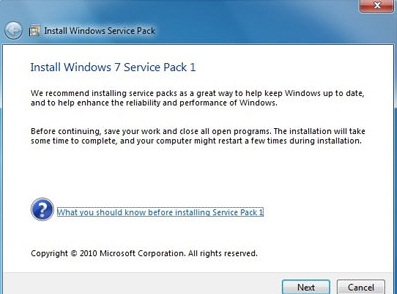
Q: Can I install the Release Candidate over the Beta of SP1?
A. No. You must uninstall the beta.
Q: Can I install the RC on an evaluation version of Windows 7 or Windows Server 2008 R2?
A. Yes. The RC of SP1 can install on RTM evaluation versions of Windows 7 and Windows Server 2008 R2.
Q: There are several downloads available. Which one should I choose?
A: There are two ways you can obtain the service pack RC. You can download a special key to enable Windows Update to offer you the service pack RC, or you can download the service pack directly. For each download method, you should choose the correct download for your platform (x86, IA64 or x64).
Q: Should customers who are considering deploying Windows 7 wait for SP1?
A: No. Windows 7 is a high quality release and provides many benefits to consumers and businesses alike. SP1 will include all updates previously available to Windows 7 users through Windows Update, so there is no reason to wait or delay their use of Windows 7.
Q. Can I upgrade from the RC builds to the final build of SP1?
A. No. You will have to uninstall the Service Pack or do a clean install of Windows 7 or Windows Server 2008 R2.
Q. Will there be a slipstream build of SP1 RC?
A. No. The RC will only be available as the service pack update itself. You will need to have a release to manufacturing (RTM) version of Windows 7 or Windows Server 2008 R2 to install the RC of the service pack.
Q. What languages will be released at RC?
A. For RC, we will release English, French, German, Japanese, and Spanish.
Q: Which improvements are included in Windows Server 2008 R2 SP1?
A.
• Dynamic Memory – Dynamic Memory allows for memory on a host machine to be pooled and dynamically distributed to virtual machines as necessary. Memory is dynamically added or removed based on current workloads, and is done so without service interruption.
• Microsoft RemoteFX – a new set of remote user experience capabilities that enable a media-rich user environment for virtual desktops, session-based desktops and remote applications
• Enhancements to scalability and high availability when using DirectAccess – improvements have been made to enhance scalability and high availability when using DirectAccess, through the addition of support for 6to4 and ISATAP addresses when using DirectAccess in conjunction with Network Load Balancing (NLB).
• Support for Managed Service Accounts (MSAs) in secure branch office scenarios – enhanced support for managed service accounts (MSAs) to be used on domain-member services located in perimeter networks (also known as DMZs or extranets).
• Support for increased volume of authentication traffic on domain controllers connected to high-latency networks – more granular control of the maximum number of possible concurrent connections to a domain controller, enabling a greater degree of performance tuning for service providers.
• Enhancements to Failover Clustering with Storage – SP1 enables enhanced support for how Failover Clustering works with storage that is not visible for all cluster nodes. In SP1, improvements have been made to the Cluster Validation and multiple Failover Cluster Manager wizards to allow workloads to use disks that are shared between a subset of cluster nodes.
Q: Which improvements are included in Windows 7 SP1?
A.
• Additional support for communication with third-party federation services – Additional support has been added to allow Windows 7 clients to effectively communicate with third-party identity federation services (those supporting the WS-Federation passive profile protocol).
• Improved HDMI audio device performance – Updates have been incorporated into SP1 to ensure that connections between Windows 7 computers and HDMI audio devices are consistently maintained.
• Corrected behavior when printing mixed-orientation XPS documents – Prior to the release of SP1, some customers have reported difficulty when printing mixed-orientation XPS documents (documents containing pages in both portrait and landscape orientation) using the XPS Viewer, resulting in all pages being printed entirely in either portrait or landscape mode. This issue has been addressed in SP1, allowing users to correctly print mixed-orientation documents using the XPS Viewer.
Q: Changes common to both client and server platforms:
A.
• Change to behavior of “Restore previous folders at logon” functionality – SP1 changes the behavior of the “Restore previous folders at logon” function available in the Folder Options Explorer dialog. Prior to SP1, previous folders would be restored in a cascaded position based on the location of the most recently active folder. That behavior changes in SP1 so that all folders are restored to their previous positions.
• Enhanced support for additional identities in RRAS and IPsec – Support for additional identification types has been added to the Identification field in the IKEv2 authentication protocol. This allows for a variety of additional forms of identification (such as E-mail ID or Certificate Subject) to be used when performing authentication using the IKEv2 protocol.
• Support for Advanced Vector Extensions (AVX) – Advanced Vector Extensions (AVX) is a 256 bit instruction set extension for processors. AVX is designed to allow for improved performance for applications that are floating point intensive. Support for AVX is a part of SP1 to allow applications to fully utilize the new instruction set and register extensions.
Windows 7 SP1: RemoteFX. Steps to provide the same user experience as though they were running on a physical computer
October 28, 2010
Leave a comment
The RemoteFX feature allows Windows 7 SP1 and applications running in virtual machines to provide the same user experience as though they were running on a physical computer.
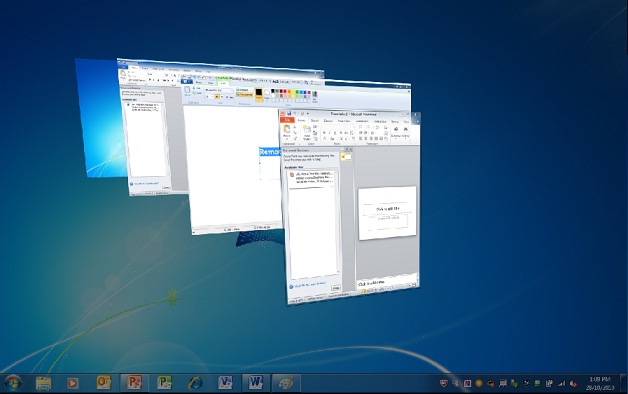
The RemoteFX feature also allows remote users to redirect local USB devices to their Remote Desktop sessions.( I will talk about this in my next article )
The following steps will help you understand how RemoteFX improves the user experience when running Windows 7 and applications in a virtualized environment :
1. Install Windows Server 2008 R2 SP1
- Verify that the appropriate device drivers have been installed for the 3D accelerated video display adapter.Unless the appropriate device drivers are installed for the 3D accelerated video display adapter, you cannot start the Windows 7 virtual machine with the RemoteFX 3D Video Adapter Support enabled
- Install the Hyper-V server role.
- Install the Remote Desktop Services server role with the following role services:
Remote Desktop Virtualization Host
Core Services
RemoteFX
2.Install Windows 7 SP1.
- Enable Remote Desktop connections
- Shutdown the Windows 7 virtual machine.
3. Enable RemoteFX 3D Video Adapter Support on Windows 7 Virtual Machine.
The RemoteFX 3D Video Adapter Support must be added to the Windows 7 virtual machine by performing the following steps on the computer running Windows Server 2008 R2 SP1:
- Start Hyper-V Manager.
- In Hyper-V Manager, select the Windows 7 virtual machine and in the Actions pane click Settings.
- In the navigation pane, under the Hardware section, click Add Hardware.
- Add the adapter; start the virtual machine; verify that the adapter is installed and then restart the machine.
- In the properties pane, click RemoteFX 3D Video Adapter, and then click Add.
- The RemoteFX 3D Video Adapter appears in the list of hardware in the Hardware section as show in the following figure.
- Start the virtual machine; verify that you can login and that you have loaded the driver. The VM will ask to be restarted at this point, perform the restart.

4. To checkout that RemoteFX is properly installed and configured :
-
Start the virtual machine running Windows 7 SP1.
-
Establish a Remote Desktop session with Windows 7 SP1 by using the Remote Desktop Connection client in Windows Server 2008 R2 SP1
- On the Local Resources tab(Remote Desktop Connection client), in Apply Windows key combinations, select one of the following:
- Only when using full screen. Select this option if you are going to run the Remote Desktop session in full screen.
- On the remote computer. Select this option if you are going to run the Remote Desktop session in a window.
- On the Experience tab, in Performance section, select LAN (10Mbps or higher) and verify that all the check boxes are selected.
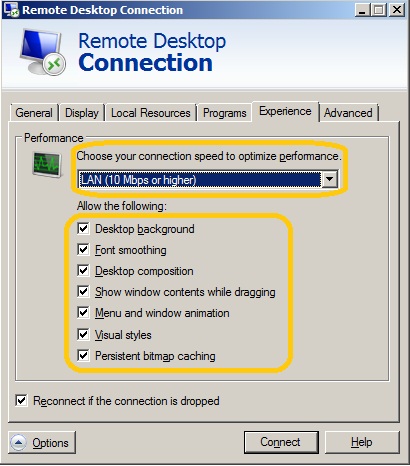
- Log on Windows 7 SP1.
- Change the theme for the Windows 7 to use an Aero theme. The desktop theme should appear with all the Aero features, such as transparency.

As you can see the RemoteFX feature allows Windows 7 SP1 and applications running in virtual machines to provide the same user experience as though they were running on a physical computer.
Other improvements in Windows 7 SP1 :
· Additional support for communication with third-party federation services – Additional support has been added to allow Windows 7 clients to effectively communicate with third-party identity federation services (those supporting the WS-Federation passive profile protocol).
· Improved HDMI audio device performance – Updates have been incorporated into SP1 to ensure that connections between Windows 7 computers and HDMI audio devices are consistently maintained.
· Corrected behavior when printing mixed-orientation XPS documents – Prior to the release of SP1, some customers have reported difficulty when printing mixed-orientation XPS documents (documents containing pages in both portrait and landscape orientation) using the XPS Viewer, resulting in all pages being printed entirely in either portrait or landscape mode. This issue has been addressed in SP1, allowing users to correctly print mixed-orientation documents using the XPS Viewer.
Windows Server 2008 R2 SP1 RC available for download
October 28, 2010
Leave a comment
You can download Windows Server 2008 R2 SP1 Release Candidate now which includes the usual bug fixes, etc… there are some specific changes for dynamic memory in there:
Download from here: http://www.microsoft.com/windowsserver2008/en/us/sp1.aspx
Some of the improvements for Windows Server 2008 R2 SP1 include:
• Dynamic Memory – Dynamic Memory allows for memory on a host machine to be pooled and dynamically distributed to virtual machines as necessary. Memory is dynamically added or removed based on current workloads, and is done so without service interruption.
• Microsoft RemoteFX – a new set of remote user experience capabilities that enable a media-rich user environment for virtual desktops, session-based desktops and remote applications
• Enhancements to scalability and high availability when using DirectAccess – improvements have been made to enhance scalability and high availability when using DirectAccess, through the addition of support for 6to4 and ISATAP addresses when using DirectAccess in conjunction with Network Load Balancing (NLB).
• Support for Managed Service Accounts (MSAs) in secure branch office scenarios – enhanced support for managed service accounts (MSAs) to be used on domain-member services located in perimeter networks (also known as DMZs or extranets).
• Support for increased volume of authentication traffic on domain controllers connected to high-latency networks – more granular control of the maximum number of possible concurrent connections to a domain controller, enabling a greater degree of performance tuning for service providers.
• Enhancements to Failover Clustering with Storage – SP1 enables enhanced support for how Failover Clustering works with storage that is not visible for all cluster nodes. In SP1, improvements have been made to the Cluster Validation and multiple Failover Cluster Manager wizards to allow workloads to use disks that are shared between a subset of cluster nodes.
Note : once the final build of SP1 ships, you’ll need to uninstall the RC version in order to upgrade.
Hyper-V 2008R2 SP1: Guest Requirements for Dynamic Memory
October 22, 2010
Leave a comment
The following Windows server operating systems support Dynamic Memory when installed as the guest operating system on a virtual machine:
- Windows Server 2008 R2 Standard Edition SP1*
- Windows Server 2008 R2 Enterprise Edition SP1
- Windows Server 2008 R2 Datacenter Edition SP1
- Windows Server 2008 R2 Web Edition SP1*
- Windows Server 2008 Standard Edition SP2*
- Windows Server 2008 Enterprise Edition SP2
- Windows Server 2008 Datacenter Edition SP2
- Windows Server 2008 Web Edition SP2*
- Windows Server 2003 R2 Standard Edition SP2 or higher*
- Windows Server 2003 R2 Enterprise Edition SP2 or higher
- Windows Server 2003 R2 Datacenter Edition SP2 or higher
- Windows Server 2003 R2 Web Edition SP2 or higher*
- Windows Server 2003 Standard Edition SP2 or higher*
- Windows Server 2003 Enterprise Edition SP2 or higher
- Windows Server 2003 Datacenter Edition SP2 or higher
- Windows Server 2003 Web Edition SP2 or higher*
Note: The Beta release of Service Pack 1 does not support Dynamic Memory for the operating systems marked with an asterisk (*) above. However, support for Dynamic Memory for these operating systems will be added in a future release of SP1.
Note: Dynamic Memory is supported for both the x86 and x64 architectures of Windows Server 2003, Windows Server 2003 R2 and Windows Server 2008.
The following Windows client operating systems for both x86 and x64 architecture also support Dynamic Memory when installed as the guest operating system on a virtual machine:
- Windows® 7 Enterprise Edition
- Windows 7 Ultimate Edition
- Windows Vista® Enterprise Edition SP2
- Windows Vista Ultimate Edition SP2
Recommended Books


System Center 2012 R2 Virtual Machine
System Center Virtual Machine Manager 2012 Cookbook


 Cloudtidings.com

