
Archive
Migrating a Hyper-v VM to Azure. What about the static IP Address?
When you have an on premises environment you normally configure the virtual machines with static IP’s ( at least in most cases ). But what happens when you want migrate to Azure?
Well some things will need to ensure first:
- The Hyper-V Virtual Machine was created as Generation 1 VM.
- The Hyper-V Virtual Machine disk was created with VHD disk and not VHDX (if you have a VHDX, convert it with the Convert-VHD Windows PowerShell cmdlet) and confirm it sizes is less than 1023GB.
- The Hyper-V Virtual Machine has only ONE network adapter and that it is of type synthetic and NOT legacy.
- The network connection is configured to obtain its IP address automatically (static IP addresses within the VM will not work).
Last February Microsoft announced the support for static IP’s on the Virtual Machines. The Virtual Network static IP feature is now available through Windows Azure PowerShell (available at the Window Azure website.) . For the steps to install Windows Azure PowerShell, see: http://www.windowsazure.com/en-us/documentation/articles/install-configure-powershell/
The commands to setup the IP are:
#Get the Virtual Machine name
PS C:\> $VM = Get-AzureVM -ServiceName YourCloudServiceName -Name VMWeb01
#Update the Virtual Machine (in my case VMWeb01) with a static IP (10.1.2.30)
PS C:\> Set-AzureStaticVNetIP -VM $VM -IPAddress 10.1.2.30 | Update-AzureVM
Also ,
#Get the assigned IP address of a Virtual Machine
PS C:\> Get-AzureStaticVNetIP -VM $VM
#Removes the static IP address of the VM
Remove-AzureStaticVNetIP – VM $VM
#Confirm availability of a certain static IP address
Test-AzureStaticVNetIP -VNetName WebServersVNet -IPAddress 10.1.2.30
syntax: Test-AzureStaticVNetIP -VNetName <network name> -IPAddress <IP address string>
NOTES :
- The virtual machine guest operating system still have to be configured to get IP from DHCP (obtain IP address automatically)
- The configuration of a static IP address can only be done by using Windows Azure PowerShell. There is no GUI
- The Virtual Machine must be part of an Azure Virtual Network.
- As oppose of what many blogs says, you can specify the static IP at any time as long as the VM is stopped. The information that you can only configure a static IP address in the context of the CREATION of the Virtual Machine is not correct
Also Microsoft is now offering VIP Reservation for a virtual Machine, which means that the virtual IP address (public IP) won’t change for example if you move the VM to a different region (e.g. USA to Singapore) or removing and redeploying the services. This together with the ExpressRoute MPLS connections, will open many scenarios like SharePoint Hybrid, External Monitoring, Database backend…
Extend your Datacenter: Integrate your on premises Hyper-V with Azure with no public Internet traffic using ExpressRoute
Microsoft announced the general availability of the Azure ExpressRoute service.
ExpressRoute allows you to connect your existing datacenters to Azure without having to flow any traffic over the public Internet, and enable–guaranteed network quality-of-service and the ability to use Azure as a natural extension of an existing private network or datacenter.
It can also be a cost-effective option for transferring large amounts of data such as datasets for high performance computing applications or moving large VMs between your dev/test environment in Azure and on-premises production environment
Microsoft is also offering enterprise SLA for the service, as well as a variety of bandwidth tiers.
Several provider partnerships with ExpressRoute are in place, including: AT&T, Equinix, Verizon, BT, Level3, TelecityGroup, SingTel and, Zadara.
Here you can find pricing details about the service: http://azure.microsoft.com/en-us/pricing/details/expressroute/
ExpressRoute will allow you to build applications that span on-premises infrastructure and Azure without compromising security or performance. For example, you can have your corporate front end intranet application running in Azure (SharePoint for example) and the back end using an on-premises SQL Server, serving all corporate users without traffic ever routing through the public Internet. This can also be used to guarantee, if you have data sovereignty policies that your data will always stays in the country.
You can get more information on the ExpressRoute website.
Virtual Machines. Security Extensions : Built-in Anti-Virus Support
Microsoft announced during TechEd NA 2014 the release of 3 new security extensions that enable Built-in Anti-Virus Support via the VM Agent for Azure Virtual Machines:
- Microsoft Antimalware
- Symantec Endpoint Protection
- TrendMicro’s Deep Security Agent
The VM Agent is a lightweight and unobtrusive process that you can optionally enable to run inside your Windows and Linux VMs. The VM Agent can then be used to install and manage extensions, which are software modules that extend the functionality of a VM and help make common management scenarios easier.
These extensions enable you to add richer security protection to the Virtual Machines hosted in Azure using industry security products.
To enable it, in the Azure Management Portal, in the Virtual Machine Configuration, check Install VM Agent and then select the desired Anti Virus protection:
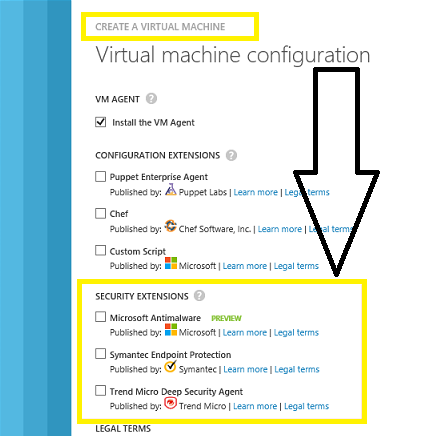
You can also use the command line (PowerShell) to enable it.
Windows Server 2012 Update – released today
Today is a big day with the release of Windows Server 2012 R2 Update!
Windows Server 2012 R2 Update is a cumulative update of every hotfix released for Win2012 R2 to date. This just radically simplified our set of recommended hotfixes.
New Win2012 R2 Cluster Recommended hotfixes:
1. Windows RT 8.1, Windows 8.1, and Windows Server 2012 R2 Update April, 2014
http://support.microsoft.com/kb/2919355
2. CSV snapshot file is corrupted when you create some files on the live volume
Springboard Series Insider – Spotlight of the month. @MSSpringboard
Microsoft Windows releases a monthly newsletter called Springboard Series Insider. This is a vastly popular online publication targeting IT Pros and anyone interested in Windows.
Only a few are listed in the Springboard Series Insider. So I am really happy and proud for this recognition. Thank you!
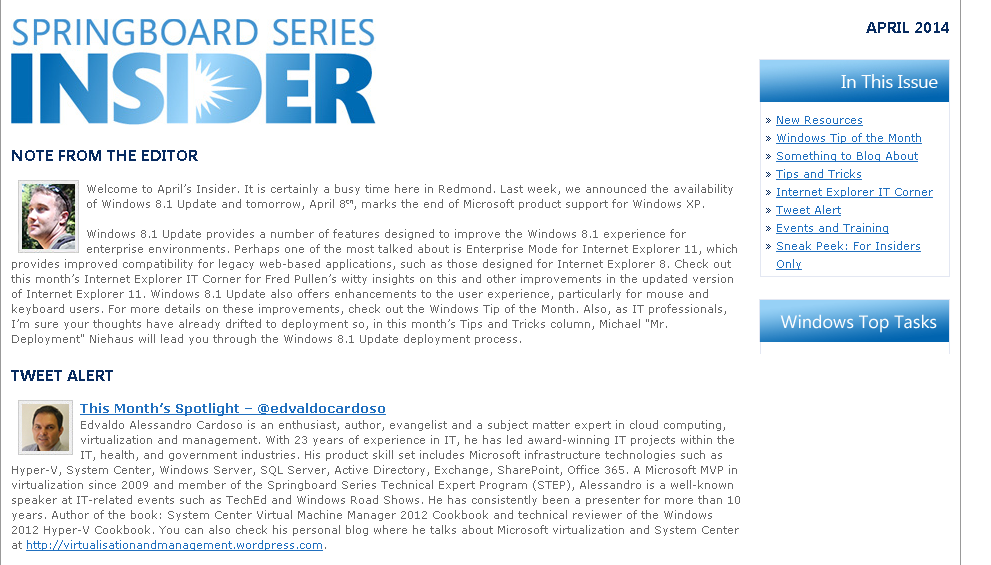
The Insider provides their subscribers with
- New Resources
- Windows Tip of the Month
- Something to Blog About
- Tips and Tricks
- Internet Explorer IT Corner
- Tweet Alert
- Events and Training
- Sneak Peek: For Insiders Only
This month the main theme is Windows 8.1 updates, which provides a number of features designed to improve the Windows 8.1 experience for enterprise environments.
If you haven’t signed up yet, now it is time :

Note: As always, if you have any suggestions on content you’d like to see or resources you need, please reach out to Microsoft anytime at springboard@microsoft.com. In the meantime, enjoy this month’s edition of the Springboard Series Insider and be sure to try out Windows 8.1 Update!
MVP Comm Camp : System Center 2012R2 Operations Manager slide decks
Hi
For those who were able to attend the MVP Community Camp last Saturday, a big thank you attending and for the positive feedbacks.
Great to hear that more and more you are utilizing System Center.
System Center 2012R2 Operations Manager – Comprehensive monitoring of physical, virtual, and cloud infrastructure. Operations Manager offers key capabilities, monitoring diverse environments, assuring physical, virtual, and cloud infrastructure health, ensuring reliable workload configurations

Through this discussion, we hope you see how System Center uniquely delivering on the key areas :
As promised, here is the slide deck for Monitoring with Operations Manager – Overview
MVP Comm Camp : System Center 2012R2 Virtual Machine Manager slide decks
Hi
For those who were able to attend the MVP Community Camp last Saturday, a big thank you attending and for the positive feedbacks.
Great to hear that more and more you are utilizing System Center.
System Center enables robust management of heterogeneous datacenters, reduce datacenter complexity and enables common management that spans Windows Server and Windows Azure environments., be it provisioning, self-service or monitoring
Through this discussion, we hope you see how System Center uniquely delivering on the key areas :
As promised, here is the slide deck for VMM System Center VMM 2012R2 – Overview
Cheers
MVP Comm Camp : Windows Server 2012R2 Hyper-V slide decks
Hi
For those who were able to attend the MVP Community Camp last Saturday, a big thank you attending and for the positive feedbacks.
The session was all about understanding the various technologies in Windows Server 2012R2 that can reduce downtime for a private cloud deployment
As promised, here is the Hyper-V – Windows 2012 R2 – Overview slide deck.
Cheers!
Software-Defined Networking with Windows Server and System Center Jump Start
Software-Defined Networking with Windows Server and System Center Jump Start
Free online event with live Q&A with the networking team: http://aka.ms/SftDnet
Wednesday, March 19th from 8am – 1pm PST
Are you exploring new networking strategies for your datacenter? Want to simplify the process? Software-defined networking (SDN) can streamline datacenter implementation through self-service provisioning, take the complexity out of network management, and help increase security with fully isolated environments. Intrigued? Bring specific questions, and get answers from the team who built this popular solution!
Windows Server 2012 R2 and System Center 2012 R2 are being used with SDN implementations in some of the largest datacenters in the world, and this Jump Start can help you apply lessons learned from those networks to your own environment. From overall best practices to deep technical guidance, this demo-rich session gives you what you need to get started, plus in-depth Q&A with top experts who have real-world SDN experience. Don’t miss it!
Register here: http://aka.ms/SftDnet
Check out the www.MicrosoftVirtualAcademy.com for other free training and live events.
FREE Microsoft MVP Event Australia and New Zealand. March 2014. Register Now
The FREE MVP Community Camp (ComCamp) is a six-day event with both Live Webcasts and In-Person Seminars. MVPs from nine countries will deliver webcasts available to anyone anywhere to learn trends and techniques from these industry leaders; the in-person seminars will be available in 22 cities across seven countries with tracks providing opportunities to connect with others in the same expertise/interest area and to have a number of technology hands-on experiences.
Delivered by MVPs who not only possess the expert knowledge in their field but also have been influential technical leaders to IT community and audiences. Each session is 60 minutes long and includes Q&A to help you get an instant feedback on questions you have had during the session. Between each session, 15 minutes break is given for MVPs and community members to network, share their thoughts on topics presented and share technical experiences.
There are sessions happening in the principal cities of Australia : Sydney, Brisbane, Melbourne, Perth and Adelaide and New Zealand. Make sure you register early to secure your spot.
Registration links:
Recommended Books


System Center 2012 R2 Virtual Machine
System Center Virtual Machine Manager 2012 Cookbook


 Cloudtidings.com